
Views: 235 Author: shandong Allstar Grinding Ball Publish Time: 2026-07-17 Origin: Site


Content Menu
● Why Grinding in Mining Matters More Than Ever
● The Allstar Advantage: Engineered for Real-World Mining Conditions
>> Core Product Lines for Mining Applications
● Deep Dive: How to Optimize Grinding in Mining with the Right Media
>> Step 1: Understand Your Ore's Work Index and Abrasiveness
>> Step 2: Match Media to Mill Type and Circuit Stage
>> Step 3: Optimize Ball Charge Distribution
● New Data: 2026 Trends Reshaping Grinding in Mining
● Case Study: How a Copper Mine in Latin America Cut Media Costs by 22%
● Practical Checklist: Is Your Grinding Media Underperforming?
● Why OEM Partners Trust Allstar for Long-Term Success
● Ready to Optimize Your Grinding Circuit?
● Frequently Asked Questions (FAQ)
Grinding in mining is the heartbeat of modern mineral processing. It determines how fast ore is liberated, how much energy is consumed, and ultimately how profitable a mine can be. At SHANDONG ALLSTAR GRINDING BALL CO., LTD., we engineer high-performance grinding media—forged steel balls, cast steel balls, grinding rods, and cylpebs—designed to withstand the toughest milling environments in mining, cement, and power generation. As a trusted global OEM partner, we help international brands, wholesalers, and producers achieve lower wear rates, higher throughput, and more consistent particle size—without compromising safety or reliability.
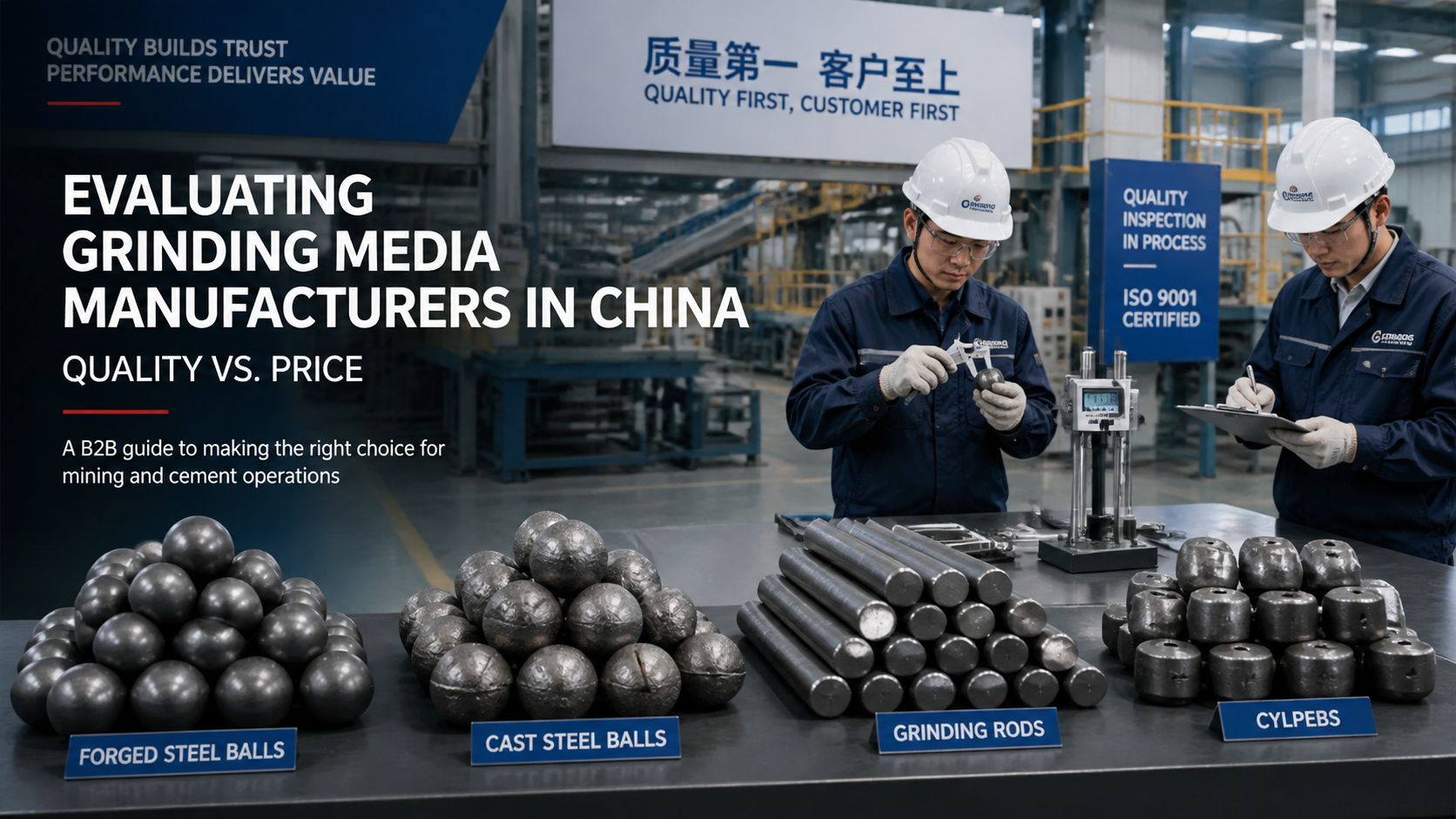
The mining industry is under constant pressure to do more with less: less energy, less downtime, less waste. Grinding circuits typically account for over 50% of a mine's total energy consumption, making media selection one of the most critical operational decisions.
Key impacts of grinding media performance:
- Energy efficiency: Better media geometry and hardness reduce specific energy consumption (kWh/t).
- Throughput stability: Uniform wear profiles prevent charge imbalance and mill vibration.
- Product size control: Consistent ball size distribution ensures target P80 is met reliably.
- Total cost of ownership (TCO): Longer-lasting media mean fewer shutdowns and lower replacement frequency.
Industry insight (2026): New coarse grinding and flotation technologies are reshaping circuit design, placing even greater emphasis on media durability and breakage mechanics.
At Allstar, we don't just supply grinding balls—we solve milling problems. Our fully automated production lines, strict metallurgical controls, and application-specific heat treatments ensure every batch meets or exceeds international standards (ISO, ASTM, JIS).
| Product Type | Typical Hardness (HRC) | Best For | Key Benefit |
|---|---|---|---|
| Forged Steel Balls | 55–65 | SAG/Ball mills, hard ore | High impact toughness, low breakage |
| Cast Steel Balls (High Chrome) | 58–68 | Cement, fine grinding | Superior wear resistance |
| Grinding Rods | 45–55 | Rod mills, primary grinding | Straightness, minimal bending |
| Cylpebs | 50–60 | Secondary/tertiary grinding | Higher surface area, efficient fine grinding |
Why global partners choose Allstar for OEM grinding media:
- ✅ Custom sizing: 20mm–150mm balls, rods up to 6m, tailored to your mill geometry.
- ✅ Consistent chemistry: Tight control over C, Cr, Mn, and residual elements.
- ✅ Traceable quality: Every heat number is documented;Certificates of Analysis provided.
- ✅ OEM flexibility: Private labeling, packaging, and logistics support for distributors.
Selecting the right grinding media isn't just about hardness—it's about matching media properties to ore characteristics, mill type, and circuit goals.
Hard, abrasive ores (e.g., copper porphyry, iron ore) demand high-impact, high-wear media. Softer, clay-rich ores may benefit from tougher, lower-hardness media to avoid overgrinding.
- SAG mills: Prioritize forged balls with high impact resistance.
- Ball mills (secondary): Use high-chrome cast balls for wear resistance.
- Rod mills: Specify straight, stress-relieved rods to avoid charge tangling.
- Fine grinding (tower/vertical mills): Consider cylpebs or smaller-diameter balls for increased surface contact.
A well-graded charge maximizes grinding efficiency:
- Primary stage: 30–40% large balls (100–120mm)
- Secondary stage: 30–40% medium balls (70–90mm)
- Tertiary stage: 20–30% small balls (40–60mm)
Pro tip: Regularly sample your mill charge. A shift in size distribution signals wear imbalance or media breakage.
The mining sector is rapidly adopting coarse particle flotation and HPGR-based circuits, which reduce the load on traditional ball mills—but they also raise the bar for media performance in the remaining fine-grinding stages.
Emerging best practices:
- Hybrid charges: Combining forged balls (for impact) with high-chrome balls (for wear) in the same mill.
- Real-time wear monitoring: Using AI-driven sensors to track media consumption and predict changeouts.
- Sustainability metrics: Mines now track grams of media wear per tonne of ore as a KPI for environmental reporting.
A mid-tier copper producer was struggling with excessive ball breakage and unplanned mill stops. After switching to Allstar's custom-forged 110mm balls with optimized carbon-manganese chemistry:
- Breakage rate dropped from 3.8% to 1.1% within 90 days.
- Mill availability increased by 6.5 hours/month.
- Specific energy consumption fell by 4.2 kWh/t due to more stable charge dynamics.
- Annual media cost savings: $1.2M on a 45,000 tpd operation.
"Allstar didn't just sell us balls—they audited our circuit, modeled wear rates, and delivered a solution that paid for itself in 5 months."— Plant Metallurgist, Latin America
Use this quick diagnostic to spot hidden inefficiencies:
- ☐ Frequent ball shortages between charges → possible high breakage or theft.
- ☐ Mill vibration or noise → uneven wear or poor ball size distribution.
- ☐ P80 drifting coarser → media too small or worn beyond effective size.
- ☐ High power draw with low throughput → inefficient media shape or hardness mismatch.
- ☐ Excessive liner wear → media too hard or angular for liner material.
If two or more boxes are checked, it's time to re-evaluate your media supplier.
We're not a trading company—we're a manufacturer with in-house R&D, testing labs, and application engineers who've solved milling challenges across six continents.
What sets us apart:
- Vertical integration: From steel billets to finished balls, we control every step.
- Metallurgical expertise: Our team includes former mill operators and metallurgists.
- Global logistics: DDP, FOB, or CIF—we handle documentation, customs, and delivery.
- OEM-ready: Co-branding, bulk packaging, andJust-in-Time delivery for distributors.
If you're a brand owner, distributor, or mine operator looking for a reliable, high-performance grinding media partner, let's talk.
Contact Allstar today for:
- Free sample evaluation
- Circuit-specific media recommendations
- OEM partnership proposals
Email: allstar@steelgrindingball.com
Phone/WhatsApp: +86 13021742216
Factory: Taitou Industrial Park, Zhangqiu District, Jinan, Shandong, China
Let's crush smarter—together.
1. What is the typical hardness range for forged grinding balls used in mining?
Forged steel balls for mining usually range from 55 to 65 HRC, balancing impact toughness and wear resistance for SAG and ball mill applications.
2. How do I know if I need cast or forged grinding media?
Choose forged balls for high-impact primary grinding (SAG mills). Opt for high-chrome cast balls in secondary/tertiary ball mills where abrasion dominates.
3. Can Allstar provide custom-sized grinding rods for rod mills?
Yes. We manufacture grinding rods from 40mm to 100mm diameter, up to 6 meters in length, with straightness tolerances under 1mm/m.
4. What certifications does Allstar hold for quality control?
Our production follows ISO 9001 principles, with full traceability from raw material to final inspection. Certificates of Analysis are provided with every shipment.
5. Do you offer OEM private labeling for distributors?
Absolutely. We support co-branding, custom packaging, and bulk pallet configurations to meet your market's requirements.
- Haitian Heavy Industry. *Complete Guide to Grinding Balls: Types, Applications, and Performance Optimization*. https://www.htwearparts.com/industry-news/grinding-balls-complete-guide-to-types-applications-and-performance-optimization.html
- IMARC Global. *Ten major mining tech trends in 2026: Part 2*. https://imarcglobal.com/news/industry/ten-major-mining-tech-trends-in-2026-part-2
- ScienceDirect. *Comparison of grinding media—Cylpebs versus balls* (F. Shi, 2004). https://www.sciencedirect.com/science/article/abs/pii/S0892687504001888
- ADS Abstract. *A Comparison of the Fine-Grinding Performance between Cylpebs and Ceramic Balls* (2022). https://ui.adsabs.harvard.edu/abs/2022Mine...12.1007L/abstract
- Shandong Allstar Grinding Ball Co., Ltd. Official Site. https://www.grindingball.com/
Hot Tags: China, Global, OEM, private label, manufacturers, factory, suppliers, manufacturing company


