
Views: 247 Author: shandong Allstar Grinding Ball Publish Time: 2026-08-20 Origin: Site


Content Menu
● Why Slurry Rheology Changes Grinding-Media Selection
● Steel Balls for Ball Mill: Strengths in Viscous Circuits
>> How Steel Balls Behave in Thick Slurry
>> Advantages of Forged Steel Grinding Balls
● Cast Grinding Cylpebs: Where They Can Add Value
>> Potential Benefits of Cast Cylpebs
>> Limits of Cylpebs in Highly Viscous Slurries
● Steel Balls vs Cast Cylpebs for Viscous Slurry
● Expert Method: Optimize Media for Rheology
>> Step 1: Characterize the Slurry
>> Step 2: Identify the Dominant Breakage Mechanism
>> Step 3: Run a Controlled Comparative Trial
>> Step 4: Select Based on Total Cost per Tonne
● Why Manufacturing Quality Matters
● Choose a Custom Media Trial with ALLSTAR
● FAQ
>> 1. Are steel balls better than cast grinding cylpebs for viscous slurry?
>> 2. Can cylpebs produce a finer grinding product?
>> 3. Should a ball mill use only one size of grinding media?
>> 4. What should be measured during a grinding-media trial?
>> 5. Does higher hardness always mean lower grinding-media cost?
>> 6. Can SHANDONG ALLSTAR GRINDING BALL CO., LTD. provide OEM grinding media?
>> 7. When should grinding cylpebs be considered instead of forged balls?
For highly viscous mineral slurries, choosing between steel balls for ball mills and cast grinding cylpebs is not simply a purchasing decision—it is a process-control decision. The wrong media geometry, alloy, size distribution, or surface condition can increase slurry resistance, restrict media mobility, reduce classification efficiency, and raise total grinding cost.
At SHANDONG ALLSTAR GRINDING BALL CO., LTD., we manufacture forged steel grinding balls, cast grinding balls, grinding cylpebs, grinding rods, and grinding segments for mining, cement, and power-generation applications. As an OEM partner for international brands, wholesalers, and manufacturers, we help customers select media based on mill conditions, slurry rheology, feed size, target fineness, and wear economics—not only nominal hardness.
This guide explains when forged steel balls or cast grinding cylpebs are more suitable for viscous slurry circuits, how media shape influences rheology, and how to build a practical testing plan before converting an operating mill.
Slurry rheology describes how a pulp flows and resists deformation. In mineral processing, a slurry may behave as a near-Newtonian fluid at low solids concentration, but highly concentrated fine-particle slurries can become non-Newtonian, with higher apparent viscosity and yield stress.
In simple terms, a viscous slurry does not move through the mill as freely as a thin slurry. It can reduce the relative motion between particles and media, cushion impacts, trap fines around the grinding charge, and create inefficient zones within the mill.
For this reason, grinding-media selection must consider more than hardness. The operating result depends on the interaction between:
- Media shape and surface area
- Media size distribution
- Slurry solids concentration
- Particle-size distribution
- Pulp viscosity and yield stress
- Mill speed and filling level
- Liner design and lift profile
- Ore abrasiveness and competency
- Target product size
Research comparing balls and cylpebs has found that media shape can affect breakage rates and product-size distribution. Under certain laboratory conditions, cylpebs produced a finer product than balls, although performance depends heavily on feed size, slurry conditions, and the specific grinding circuit.
The practical message is clear: there is no universally superior grinding media. The best choice is the one that creates effective collision energy and slurry movement under your actual mill conditions.
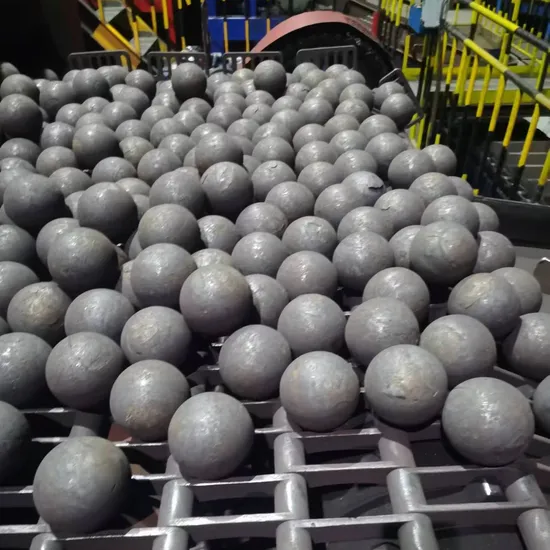
Forged steel balls are widely used in primary ball milling, secondary grinding, cement milling, and many mineral-processing applications. Their spherical shape supports predictable motion, stable contact behavior, and strong impact performance.
At SHANDONG ALLSTAR GRINDING BALL CO., LTD., forged steel balls can be supplied in customized diameters, hardness ranges, chemical compositions, and packaging formats to support OEM requirements and diverse mill environments.
A spherical ball has a relatively low contact area compared with a cylindrical media shape of similar nominal size. In thick slurry, this can help maintain movement and reduce the tendency for excessive media-to-media friction.
Steel balls are often selected when the circuit requires:
- High impact energy for coarse particle breakage
- Better resistance to breakage and deformation
- Stable rolling and cascading behavior
- More predictable wear profiles
- A broad media-size range, including larger diameters
- Lower risk of shape-related packing effects in high-solids pulp
The round geometry also allows more consistent charge motion when slurry viscosity rises. Rather than assuming that high surface area always improves grinding, operators must assess whether the slurry can circulate effectively around the media charge.
| Operating factor | Forged steel balls |
|---|---|
| Impact resistance | Typically strong, especially for coarse grinding duties |
| Media movement | Stable rolling, cascading, and cataracting behavior |
| Suitability for coarse feed | Excellent when adequate impact energy is required |
| Shape retention | Generally good with appropriate forging and heat treatment |
| Size availability | Broad range, suitable for grading strategies |
| Viscous slurry performance | Often advantageous when mobility and impact must be preserved |
| OEM customization | Alloy, diameter, hardness, and packing can be tailored |
A useful industry comparison reported that, under one specific test condition, 30 mm steel grinding balls showed lower wear and lower sieve residue than cast-iron cylpebs after 150 operating hours. This should not be treated as a universal result, but it reinforces the need to evaluate wear, shape retention, and finished-product performance together.
Cast grinding cylpebs are short cylindrical grinding media, commonly used where fine grinding and high grinding contact frequency are important. Compared with spherical balls, cylpebs can provide more contact edges and a greater effective surface area.
This geometry can be helpful in selected fine-grinding applications, especially where the feed is already relatively fine and the circuit requires increased abrasion and attrition rather than high-impact breakage.
Cast grinding cylpebs may be appropriate when a mill requires:
- Fine-grinding support after coarse reduction is completed
- Higher contact frequency within a smaller media-size range
- Improved abrasion and attrition action
- A finer product size distribution in suitable applications
- A targeted media blend rather than a full conversion from balls
Studies of quartz grinding have reported higher breakage rates and finer products with cylpebs under certain experimental conditions. However, those results depend on variables such as grinding time, feed size, media loading, slurry viscosity, and mill configuration.
Cylpebs are not automatically the best answer for viscous pulp. Their non-spherical geometry can increase interlocking, friction, and packing effects. In a high-solids slurry with fine particles, this may reduce effective charge movement.
Potential risks include:
- Reduced media mobility when slurry viscosity is very high
- Higher likelihood of packing or localized dead zones
- Less efficient impact breakage for coarse, competent feed
- Shape degradation over time, depending on casting quality and alloy
- Greater sensitivity to process conditions than a conventional ball charge
The decision should therefore focus on the complete circuit. A media type that produces a finer laboratory product may still underperform at plant scale if it disrupts throughput, cyclone classification, pump efficiency, or liner life.
| Selection criterion | Forged steel balls | Cast grinding cylpebs |
|---|---|---|
| Primary grinding | Usually preferred | Usually secondary option |
| Coarse feed | Strong choice | Less suitable in many cases |
| Fine grinding | Effective with correct smaller sizes | Often advantageous in suitable circuits |
| Impact breakage | High | Moderate |
| Abrasion and attrition | Good | Often high due to geometry |
| Charge mobility in viscous pulp | Often more stable | Can be sensitive to packing |
| Product fineness | Controlled through media sizing and loading | Can support finer products |
| Wear behavior | Depends on alloy, heat treatment, ore, and chemistry | Depends strongly on casting integrity and alloy |
| Best implementation approach | Graded ball charge | Controlled trial or blended charge |
For many operations processing highly viscous slurry, the most practical solution is not "balls versus cylpebs." It is a designed media strategy: larger forged steel balls for breakage energy, combined with smaller balls or a limited cylpeb fraction for fine-particle attrition.
Molycop also markets multiple grinding-media formats—including SAG balls, grinding balls, rods, and cylpebs—reflecting the fact that media selection must be matched to the intended application rather than treated as a one-size-fits-all choice.
At SHANDONG ALLSTAR GRINDING BALL CO., LTD., we recommend evaluating grinding media through a structured plant or pilot test. A purchase decision based only on unit price may overlook energy use, media consumption, throughput loss, and downstream recovery impacts.
Start with representative operating data:
1. Measure slurry density and percent solids.
2. Determine particle-size distribution for feed and discharge.
3. Measure apparent viscosity at relevant shear rates where possible.
4. Identify whether the slurry shows yield-stress or shear-thinning behavior.
5. Record cyclone overflow, mill power draw, throughput, and circulating load.
Highly viscous slurry can behave differently at laboratory and full-scale mill conditions. Research on slurry density and media size emphasizes that slurry transport and classifier behavior can affect full-scale outcomes, so plant validation remains essential.
Ask a simple but important question: does the material need more impact, more abrasion, or both?
- Choose a stronger forged-ball emphasis when the feed is coarse, hard, or competent.
- Consider smaller media or a controlled cylpeb fraction when the feed is already fine and the circuit needs more attrition.
- Avoid reducing media size too quickly if coarse particles remain in the mill feed.
- Do not use one media diameter for all grinding stages unless testing proves it is appropriate.
A valid comparison should keep all major operating conditions stable:
- Same ore source and feed blend
- Same mill speed and liner condition
- Same ball filling and pulp density target
- Same classification settings
- Same trial duration and sampling schedule
- Same product-size and wear measurement method
Track at least the following indicators:
| KPI | Why it matters |
|---|---|
| Throughput | Indicates whether media supports practical mill capacity |
| Specific energy | Shows energy required per tonne processed |
| Product P80 | Measures grinding effectiveness |
| Circulating load | Highlights classification and transport changes |
| Media consumption | Captures actual wear cost |
| Liner condition | Identifies mechanical side effects |
| Pump and cyclone performance | Detects rheology-related downstream impacts |
The best grinding media is rarely the product with the lowest purchase price. A proper decision should calculate total cost per tonne of finished product:
A media option may cost more per tonne delivered but reduce consumption, stabilize output, or improve product fineness. That can make it the more economical choice over the full campaign.
The comparison between steel balls and cast grinding cylpebs is incomplete without considering manufacturing quality. Two products with the same nominal diameter and hardness may behave very differently if their chemistry, microstructure, heat treatment, and dimensional consistency are not controlled.
For forged grinding balls, important quality considerations include:
- Chemical composition control
- Uniform hardness from surface to core
- Adequate impact toughness
- Low breakage risk
- Roundness and dimensional consistency
- Stable wear performance
For cast grinding cylpebs, buyers should assess:
- Casting integrity
- Internal defect control
- Hardness consistency
- Alloy suitability for the slurry chemistry
- Shape retention during service
- Actual wear rate under site conditions
A high-chromium casting may deliver strong abrasion resistance in certain environments, while forged steel can provide better toughness and impact resistance where larger feed and heavy impact dominate. Published industry guidance also notes that relative performance between high-chrome and forged media varies with the milling environment.
For highly viscous slurries, forged steel balls are often the safer starting point when the process requires reliable charge movement, strong impact energy, and robust shape retention. Cast grinding cylpebs can add value in selected fine-grinding stages, but they should be validated carefully where pulp density, yield stress, and packing behavior are high.
SHANDONG ALLSTAR GRINDING BALL CO., LTD. supports global OEM brands, distributors, and industrial users with customized grinding media for mining, cement, and power plants. We can help you evaluate forged steel balls, cast steel balls, grinding cylpebs, grinding rods, and grinding segments based on your actual mill data.
Contact SHANDONG ALLSTAR GRINDING BALL CO., LTD. to request a customized grinding-media recommendation, OEM specification review, or comparative trial plan for your ball-mill circuit.
Often, forged steel balls are a strong starting choice because their spherical geometry can support stable charge movement and high impact energy. However, the final selection should depend on feed size, slurry rheology, target fineness, and plant trial results.
They can under suitable conditions. Cylpebs may generate more contact points and abrasion action, which can support fine grinding. Their effectiveness must still be confirmed for the specific ore and slurry environment.
Usually not. A graded media charge can combine large media for coarse-particle breakage with smaller media for fine grinding. The optimum size distribution should be developed through process data and comparative testing.
Measure throughput, mill power draw, specific energy, product P80, circulating load, grinding-media consumption, liner wear, slurry density, and downstream pump or cyclone performance.
No. Very high hardness may improve abrasion resistance, but toughness, breakage resistance, alloy compatibility, and process performance also matter. The best decision is based on total cost per tonne, not hardness alone.
Yes. We support OEM requirements for international brands, wholesalers, and manufacturers. Customization can include product type, diameter, chemical composition, hardness, packaging, labeling, and supply specifications.
Consider cylpebs when feed is relatively fine, the circuit needs more attrition grinding, and trial evidence shows that cylpebs improve product fineness or energy efficiency without harming slurry transport and throughput.

1. [Metso — Grinding Solutions and Mill Expertise]
2. [Molycop — Grinding Media Product Range]
5. [OneTunnel — Interactions Between Slurry Density and Grinding Media Size]
6. [911 Metallurgist — Factors Affecting Grinding Media Wear Rate]
7. [Preprints.org — Grinding Media in Ball Mills: A Review]
8. [International Mining — Molycop Expands SAG Ball Production Capabilities in Indonesia]
Hot Tags: China, Global, OEM, private label, manufacturers, factory, suppliers, manufacturing company


