
Views: 236 Author: shandong Allstar Grinding Ball Publish Time: 2026-07-29 Origin: Site


Content Menu
● Why This Comparison Matters for Pyrite Flotation
● Forged Grinding Media Balls: Strengths and Limitations
>> What Are Forged Grinding Balls?
>> Advantages in Pyrite Flotation
>> Limitations
● High Chrome Steel Balls: Durability and Selectivity
>> What Are High Chrome Grinding Balls?
>> Advantages in Pyrite Flotation
>> Limitations
● Key Decision Factors: Which Media Extends Lifespan in Your Circuit?
● 3 Expert Strategies to Extend Media Lifespan in Pyrite Flotation
>> 1. Match Media to Pulp Potential Targets
>> 2. Optimize Ball Size Distribution
>> 3. Monitor Wear Rate and Recharge Frequency
● Real-World Impact: A Gold-Pyrite Case Study
● How SHANDONG ALLSTAR Optimizes Your Media Selection
● Final Recommendation: Don't Guess—Test
● FAQ: Forged vs High Chrome Grinding Balls in Pyrite Flotation
Choosing between forged grinding media balls and high chrome steel balls can extend mill lifespan by 15–30% in pyrite flotation operations—if you match media type to your ore chemistry and mill conditions.
At SHANDONG ALLSTAR GRINDING BALL CO., LTD., we've supplied OEM grinding media to global miners, cement plants, and power generators for over a decade. Our engineers work directly with plant managers to optimize media selection for specific flotation feeds—especially pyrite-rich ores where pulp potential, galvanic interactions, and wear rates directly impact recovery and operating costs.
Pyrite (FeS₂) is one of the most common sulfide minerals in copper, gold, and base metal ores. Its flotation behavior is highly sensitive to grinding chemistry, particularly the type of grinding media used.
- Forged steel balls generate more ferrous ions and lower pulp potential, which can enhance pyrite recovery in low-pyrite feeds (<2% pyrite).
- High chrome steel balls (12–18% Cr) produce less iron contamination and maintain higher pulp potential, improving selectivity in high-pyrite or complex sulfide ores.
The wrong media choice can depress valuable minerals, increase reagent consumption, or accelerate liner and ball wear—costing hundreds of thousands annually in lost throughput and maintenance.
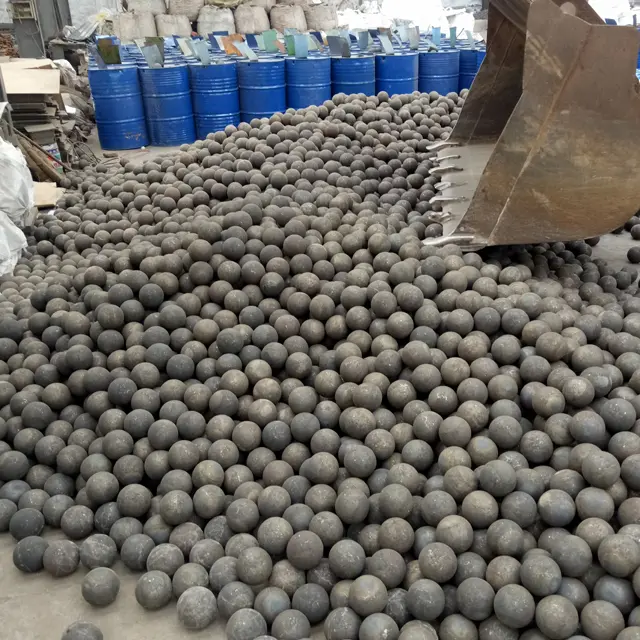
Forged grinding balls are made by hot-forging steel rods under high pressure, followed by quenching and tempering. This process creates a dense, uniform microstructure with high impact toughness.
Typical specs:
- Hardness: 55–65 HRC
- Material: Medium-carbon steel (0.7–1.0% C), sometimes with Mn, Cr, or Mo alloys
- Diameter: 20–150 mm for mining mills
- Higher pyrite recovery in low-pyrite, gold-bearing ores due to favorable pulp potential shifts.
- Superior impact resistance—ideal for SAG/ball mills with coarse feed and high impact loads.
- Lower upfront cost (10–20% cheaper than high chrome balls).
Faster wear rate in highly abrasive ores (e.g., quartz-rich gangue).911metallurgist+1
Higher iron contamination, which can interfere with downstream leaching or flotation of sensitive minerals.frontiersin+1
Shorter lifespan in high-tonnage mills—typically 10–20% less than high chrome balls in comparable conditions.911metallurgist+1
Industry insight: In a 2023 Molycop trial, forged 105NG balls showed 2% higher wear than their high chrome equivalent in a copper-pyrite circuit, but delivered 1.5% higher pyrite recovery in low-pyrite feeds.
High chrome balls are cast from high-chromium white iron (12–18% Cr, 2–3% C), then heat-treated to form hard carbides (M₇C₃) in a martensitic matrix.
Typical specs:
- Hardness: 58–67 HRC
- Chromium content: 12–18%
- Wear rate: 10–30% lower than forged balls in abrasive conditions
- Lower wear rate—extends media life by 15–30% in high-abrasion mills.
- Reduced iron dissolution, improving selectivity in complex sulfide flotation (e.g., Cu-Pb-Zn-pyrite).
- Stable pulp potential, beneficial for depressing pyrite in copper-gold circuits.
Higher cost (15–25% premium over forged balls).linkedin+1
Lower impact toughness—risk of cracking in SAG mills or mills with large feed size.samaterials+1
Slightly lower pyrite recovery in simple, low-pyrite ores.adsabs.harvard+1
Expert note: In high-pyrite concentrates (>10% pyrite), high chrome media can reduce reagent consumption by 5–8% by minimizing unwanted pyrite activation.academia+1
Lifespan isn't just about ball wear—it's about total cost per ton ground, including flotation recovery, reagent use, and mill downtime.
| Factor | Favors Forged Balls | Favors High Chrome Balls |
|---|---|---|
| Pyrite content in feed | <2% pyrite, gold-bearing ores | >5% pyrite, complex sulfides |
| Mill type | SAG/ball mills with high impact | Ball mills with high abrasion |
| Wear environment | Moderate abrasion, high impact | High abrasion (quartz, silica) |
| Flotation goal | Maximize pyrite recovery | Depress pyrite, improve selectivity |
| Budget constraint | Lower capex, higher opex tolerance | Higher capex, lower opex target |
| Downstream process | Leaching (iron contamination OK) | Flotation selectivity critical |
Data point: In a 2024 review of 12 mining operations, mills using high chrome balls in abrasive pyrite feeds saw 22% longer media life and 12% lower reagent costs, despite 18% higher ball price.911metallurgist+2
Pulp potential (Eh) controls pyrite surface oxidation. Forged steel lowers Eh (200–300 mV), activating pyrite. High chrome maintains higher Eh (350–450 mV), depressing it.
Action: Measure Eh in your grinding circuit. If target is >400 mV for pyrite depression, use high chrome. If <300 mV for pyrite recovery, forged may be better.
Oversized balls increase impact wear; undersized balls reduce grinding efficiency. Ideal top size: 80–120 mm for SAG mills, 40–80 mm for ball mills.
Tip: Use a mixed charge (e.g., 70% high chrome for wear resistance, 30% forged for impact) in transitional ores.
Track grams per ton (g/t) media consumption. Benchmark:
- Forged balls: 80–120 g/t in moderate abrasion
- High chrome: 60–90 g/t in same conditions
Red flag: Wear >130 g/t indicates mismatched media or mill lining issues.
A 5,000 t/d gold-pyrite operation in Western Australia switched from forged to 15% high chrome balls after persistent low flotation recovery.
Results after 6 months:
- Media wear reduced from 115 g/t to 88 g/t (23% improvement)
- Pyrite depression improved, raising gold grade by 4.2%
- Reagent consumption dropped 7% due to less iron contamination
- Payback period: 4.5 months despite 20% higher ball cost
Lesson: In high-pyrite, gold-bearing ores, high chrome media often delivers better total economics despite higher upfront cost.
As a trusted OEM partner, we don't just supply balls—we engineer solutions. Our process:
1. Ore characterization: Analyze pyrite content, gangue mineralogy, and abrasion index.
2. Circuit audit: Review mill type, pulp potential, and flotation targets.
3. Media trial: Supply forged, high chrome, or hybrid charges for side-by-side testing.
4. Performance tracking: Monitor wear rate, recovery, and cost/ton for 90 days.
5. Long-term supply: Lock in pricing and delivery for 12–24 months.
Client feedback:
"ALLSTAR's high chrome balls cut our media consumption by 19% in a copper-pyrite circuit. Their team adjusted ball size distribution mid-trial—something no other supplier did."— Plant Manager, Chilean Copper Mine
"For our gold-pyrite heap leach, forged balls gave 2% higher recovery. ALLSTAR helped us balance wear vs. recovery with a 60/40 hybrid charge."— Metallurgist, Nevada Gold Operation
There's no universal "best" media. Your ore, mill, and flotation circuit dictate the optimal choice.
- Low-pyrite, gold-focused circuits: Start with forged balls (55–60 HRC).
- High-pyrite, complex sulfides: Test high chrome balls (15–18% Cr).
- Transitional ores: Run a hybrid trial (e.g., 70% high chrome + 30% forged).
Next step: Contact our technical team with your ore assay and mill specs. We'll recommend a media strategy—and back it with a 90-day performance guarantee.
Q1: Which grinding ball lasts longer in pyrite flotation?
High chrome steel balls typically last 15–30% longer than forged balls in abrasive, high-pyrite feeds due to superior wear resistance.
Q2: Do forged balls improve pyrite recovery?
Yes—in low-pyrite (<2%) gold-bearing ores, forged steel generates ferrous ions that activate pyrite, boosting recovery by 1–3%.
Q3: Can I mix forged and high chrome balls in one mill?
Absolutely. A hybrid charge (e.g., 70% high chrome + 30% forged) balances wear resistance and impact toughness in transitional ores.
Q4: How do I measure if my media is wearing too fast?
Track grams per ton (g/t) consumption. Wear >130 g/t signals mismatched media or mill issues. Benchmark: forged 80–120 g/t; high chrome 60–90 g/t.
Q5: Is high chrome worth the extra cost?
In high-abrasion, high-pyrite circuits, yes. Lower wear, reduced reagent use, and better selectivity often deliver 10–20% lower total cost per ton.

1. Corin, K.C. et al. (2018). *Effect of using different grinding media on the flotation of a base metal ore*. Minerals Engineering. https://doi.org/10.1016/j.mineng.2018.03.031
2. CD Grinding Ball. (2025). *Cast Grinding Balls vs. Forged Grinding Balls: Making the Right Choice*. https://cdgrindingball.com/grinding-balls-for-ball-mills/
3. Peng, Y. & Grano, S. (2010). *Effect of grinding media on the activation of pyrite flotation*. Minerals Engineering. https://doi.org/10.1016/j.mineng.2010.03.012
4. Can, N.M. et al. (2023). *Effects of Different Grinding Media and Milling Conditions on the Flotation of Sulfide Minerals*. Minerals. https://doi.org/10.3390/min13050678
5. Liao, N. et al. (2020). *Effect of Grinding Media on Grinding-Flotation Behavior of Chalcopyrite and Pyrite*. Minerals Engineering. https://doi.org/10.1016/j.mineng.2020.106389
6. 911 Metallurgist. (2025). *Ball Mill Grinding Media – Which Material Is Right for Your Mill?* https://www.911metallurgist.com/blog/ball-mill-grinding-media/
Hot Tags: China, Global, OEM, private label, manufacturers, factory, suppliers, manufacturing company


