
Views: 270 Author: shandong Allstar Grinding Ball Publish Time: 2026-10-30 Origin: Site


Content Menu
● Why Selecting Grinding Media for Refractory Material Processing Requires a Different Approach
● Start with a Material and Process Specification
>> Define the Feed and Finished Powder
>> Describe the Grinding Equipment
● Comparing Grinding Media for Refractory Raw Materials
>> Forged Steel Balls: Evaluate Toughness Alongside Hardness
>> Cast Grinding Media: Match the Alloy to the Duty
>> Ceramic Media: Consider Purity Without Assuming Zero Wear
● Treat Contamination as a Measurable Budget
>> Establish the Allowance Before the Trial
>> Measure What Enters the Product
● Match Media Size to Feed Size and Target Fineness
>> Avoid a Universal Ball-Size Recommendation
>> Maintain the Charge Over Time
● Validate Media with a Controlled Trial
>> Step 1: Establish a Baseline
>> Step 2: Change One Main Variable
>> Step 3: Apply Pass–Fail Criteria
>> Step 4: Verify Downstream Suitability
● Compare Total Cost per Accepted Tonne
● Build an OEM Specification with SHANDONG ALLSTAR
● Request an Application-Based Media Review
>> 1. What is the best grinding media for refractory material processing?
>> 2. Can forged steel balls grind high-alumina raw materials?
>> 3. Are high-chromium cast balls always better than forged balls?
>> 4. Does higher hardness always mean lower grinding cost?
>> 5. Should refractory processors always use smaller grinding balls?
>> 6. What information should an OEM buyer provide?
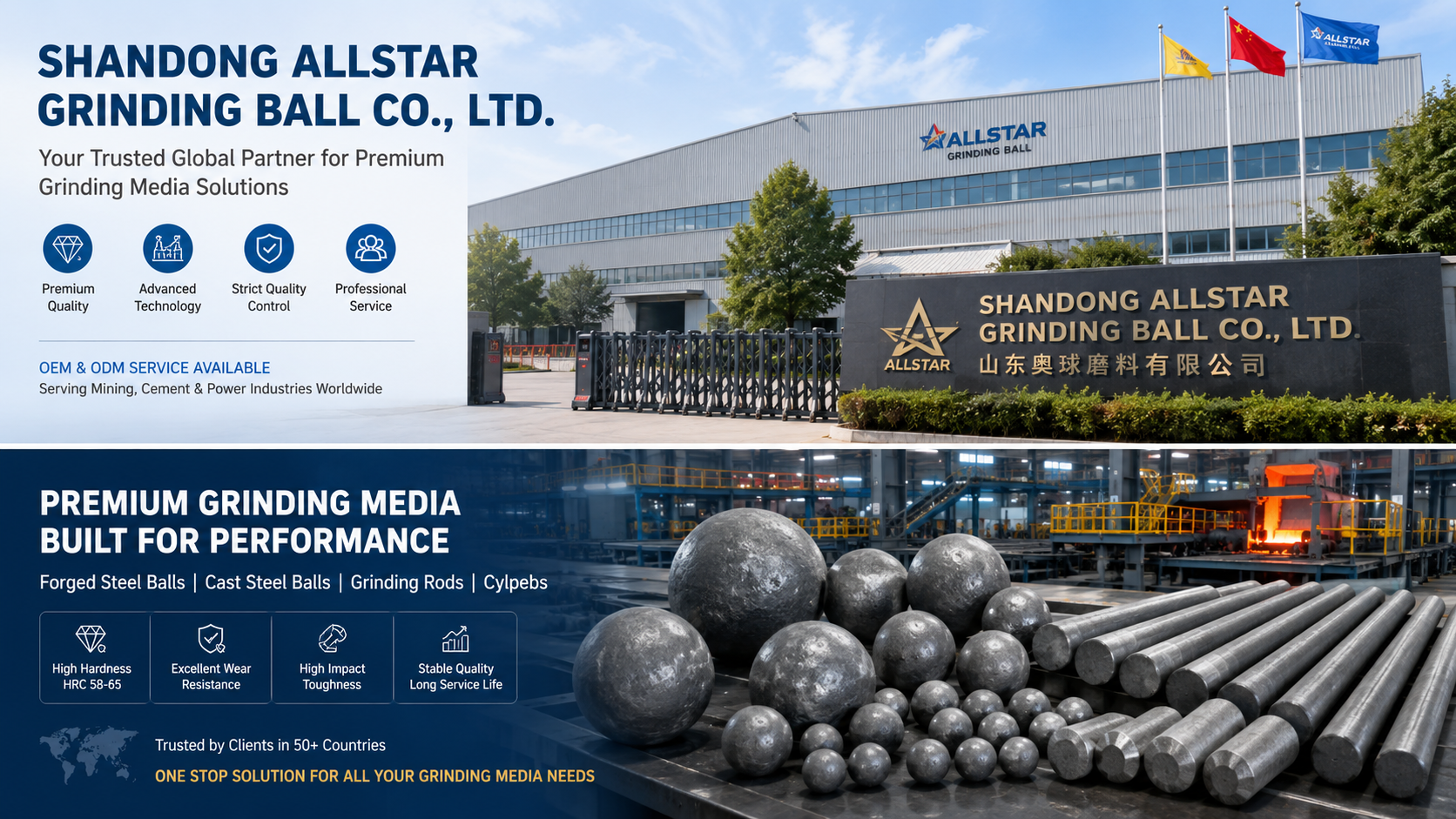
SHANDONG ALLSTAR GRINDING BALL CO., LTD. manufactures grinding balls, forged steel balls, cast grinding balls, grinding rods, and grinding cylpebs for mining, cement, and power applications, with OEM services for overseas brands, wholesalers, and manufacturers. For buyers selecting grinding media for refractory material processing, our starting point is straightforward: match the media to the material, mill, and finished-product requirements—not simply the lowest price per tonne.
Refractory processing requires particular care. A grinding charge must reduce particle size without introducing unacceptable contamination, excessive fines, or unpredictable wear. The right choice balances grinding efficiency with the chemical and physical requirements of the finished refractory.
This guide explains how to evaluate media materials, establish a practical specification, and validate performance before committing to regular supply.

Refractory raw materials include alumina, bauxite, magnesia, silica, zircon, and silicon carbide. These materials do not share one universal grinding requirement.
Some applications prioritize throughput. Others require strict chemical purity, controlled particle-size distribution, or minimal discoloration. Consequently, media that perform well in one production line may be unsuitable for another.
The central question is not, "Which grinding ball is hardest?"
It is, "Which media can produce the required powder consistently, within the contamination limit, at the lowest total processing cost?"
That distinction matters because grinding-media wear becomes part of the process. Even a durable ball can be the wrong choice if its wear products compromise the refractory formulation.
Before comparing forged steel grinding balls, cast media, or ceramic alternatives, prepare a written application profile.
Record the following:
- Raw-material identity and chemical composition.
- Feed particle-size distribution, including the largest particles.
- Required final particle-size distribution.
- Permitted iron, chromium, and other introduced elements.
- Moisture content and whether grinding is wet or dry.
- Required throughput and acceptable oversize fraction.
Avoid specifying only an average particle size. Two powders can have similar median sizes but different coarse tails and fine-particle contents.
Where relevant, include D10, D50, and D90: the particle diameters below which 10%, 50%, and 90% of the measured distribution fall. Specify the measurement method and reporting basis.
Provide the mill type, dimensions, operating speed, liner material, installed power, and current media charge.
For wet grinding, include solids concentration, slurry viscosity, pH, and operating temperature.
These details help distinguish a material-selection problem from a process problem. Changing grinding balls will not necessarily correct unsuitable feed preparation, unstable slurry conditions, or worn internal components.
No media category is universally superior. The following comparison provides a starting point, not a substitute for application testing.
| Media category | Potential application | Main selection concern |
|---|---|---|
| Forged steel balls | Impact-intensive duties where metallic contamination is acceptable | Toughness, wear, and introduced iron |
| High-chromium cast media | Abrasive duties where the selected alloy suits operating conditions | Abrasion resistance, impact suitability, and chromium limits |
| Grinding rods | Rod mills requiring a suitable coarse-grinding stage | Mill compatibility, straightness, and wear |
| Grinding cylpebs | Compatible ball-mill applications requiring evaluation of an alternative shape | Charge behavior, wear pattern, and product distribution |
| Ceramic media | Purity-sensitive or fine-grinding applications | Composition compatibility, density, wear, and equipment suitability |
Forged steel grinding balls are an option where impact resistance and resistance to breakage are important.
However, surface hardness alone does not establish suitability. Buyers should also evaluate internal soundness, hardness consistency, dimensional tolerances, and performance under representative operating conditions.
For refractory processing, steel media remain conditional on the product's contamination allowance.
High-chromium cast media can provide strong abrasion resistance in suitable applications. Their performance still depends on alloy composition, microstructure, heat treatment, and the balance between abrasion and impact.
Do not assume that every cast ball has equivalent properties. Specify the required material grade and verification method rather than relying on a generic "high-chrome" description.
Where metallic contamination is unacceptable, ceramic media may deserve priority.
Nevertheless, ceramic media also wear. Their composition must be compatible with the refractory formulation, and their density and mechanical properties must suit the mill.
SHANDONG ALLSTAR's stated product range focuses on metallic media. A responsible recommendation should acknowledge when a purity-sensitive application requires evaluation of a nonmetallic alternative.
One of the most useful improvements to media selection is replacing "low contamination" with a numerical acceptance limit.
Start with the finished-product specification. Then account for contributions from:
1. The incoming raw material.
2. Grinding-media wear.
3. Liners and other contact surfaces.
4. Handling equipment and cross-contamination.
The remaining allowance determines how much additional contamination the grinding stage can tolerate.
If the incoming material already approaches the specification limit, even modest media wear may be unacceptable.
Track media consumption and analyze representative product samples.
A simplified screening calculation is:
This assumes all worn media enters the measured product stream. Actual results may differ because of separation, retained material, or other losses.
Use chemical analysis to verify the outcome. Magnetic separation may remove some ferromagnetic contamination, but it should not be assumed to eliminate every media-derived impurity.
Larger media generally provide greater individual impact energy, helping break larger feed particles. Smaller media provide more contact opportunities within a given charge volume and can improve fine grinding when sufficient breakage energy remains available.
Neither principle justifies choosing the largest or smallest available size.
The appropriate diameter depends on:
- Feed size and material breakage behavior.
- Target fineness.
- Mill design and operating conditions.
- Media density and charge configuration.
A size suitable for a tumbling ball mill should not automatically be transferred to an attritor or stirred-media mill.
Ask the equipment manufacturer to confirm operating limits before changing the charge.
Media become smaller as they wear. Consequently, the operating charge differs from the original loading.
A make-up schedule should maintain a useful size distribution rather than simply replace lost mass without checking charge condition.
Inspect for broken pieces, heavily worn media, and changes in product distribution. These observations can reveal problems that a single consumption figure misses.
A small, well-designed trial is more useful than an unsupported promise of longer service life.
Record current performance under stable conditions:
- Throughput at the required product specification.
- Specific energy consumption.
- Media consumption.
- Product chemistry and particle-size distribution.
- Breakage, downtime, and rejected production.
Document the sampling method so subsequent comparisons remain meaningful.
Compare media grades, sizes, or suppliers without simultaneously changing every operating condition.
Keep feed characteristics, mill settings, and product targets as consistent as practical. Where variation is unavoidable, record it.
A mixed charge containing old and new media can obscure results. Account for the transition period before attributing performance to the replacement product.
Agree on acceptance criteria before reviewing the results.
A candidate should first meet chemistry, particle-size, and operational requirements. Only then should purchasing compare its economic performance.
For refractory manufacturing, acceptable powder is not necessarily the final proof.
Where applicable, evaluate the powder in the intended formulation and check the customer's relevant forming, drying, firing, and service-performance requirements.
This prevents a grinding-stage improvement from creating a downstream quality problem.
Purchase price per tonne of grinding media is only one part of the decision.
A practical comparison includes:
Use the same accounting boundary and evaluation period for every candidate.
A cheaper medium may become more expensive if it wears quickly, increases energy use, or contributes to rejected batches. Conversely, a higher-priced medium offers no advantage unless its performance justifies the premium.
Also track throughput separately. A media change that reduces wear but restricts production may not improve overall economics.
Avoid supplier comparisons based on percentages without a stated baseline, operating conditions, and product-quality target.
For overseas brands, wholesalers, and manufacturers, repeatability matters as much as initial trial performance.
When discussing an OEM grinding-media order with SHANDONG ALLSTAR GRINDING BALL CO., LTD., use the validated application requirements to define the purchasing specification.
Include:
- Product type, nominal dimensions, and tolerances.
- Agreed chemical composition.
- Hardness range and testing locations.
- Sampling and acceptance procedures.
- Requirements for breakage or impact testing, where applicable.
- Batch identification and requested inspection documents.
- Packaging, marking, and shipment requirements.
Confirm which tests, documents, and customization options are available before placing the order. Do not assume that a requested feature is automatically included.
For private-label supply, agree on product descriptions and approved technical claims. Marketing statements should remain consistent with the actual specification and supporting evidence.
The most reliable selection process begins with process information, not a price list.
Send SHANDONG ALLSTAR your raw-material specification, mill details, feed and target particle sizes, contamination limits, and current operating results.
Request a proposed media specification and trial plan, then compare candidates against your agreed acceptance criteria.
The objective is consistency: grinding media that support predictable powder quality, manageable wear, and dependable purchasing decisions.
There is no universal best option. Select according to contamination limits, feed size, target fineness, mill design, and operating conditions. Metallic media require particular scrutiny when product purity is critical.
They may be suitable where the equipment and contamination allowance permit. High alumina content alone does not establish suitability. Test introduced iron and confirm that the finished formulation remains acceptable.
No. High-chromium cast media can offer strong abrasion resistance, while forged media may suit impact-intensive conditions. Compare the specific grades in the actual duty rather than choosing by category alone.
No. Hardness must be considered alongside toughness, wear mechanism, breakage behavior, contamination, and throughput. A hard medium that causes operational or quality problems may increase total cost.
No. Smaller media can support fine grinding, but they may lack sufficient impact energy for coarse feed. Select size according to both the incoming material and required finished powder.
Provide the material chemistry, contamination limits, mill type, operating conditions, feed and target particle sizes, desired dimensions, and acceptance requirements. Include packaging and private-label requirements when relevant.
1. Union Process — *Attrition Mill Grinding of Refractories*.
2. Union Process — *Grinding Media: Selection Factors*.
3. Union Process — *Choose the Right Grinding Mill*.
4. Union Process — *Grinding Kinetics and Media Wear during Attrition Milling*.
5. Magotteaux — *Cast High Chromium*.
6. Magotteaux — *Grinding Media Forged*.
Hot Tags: China, Global, OEM, private label, manufacturers, factory, suppliers, manufacturing company


